
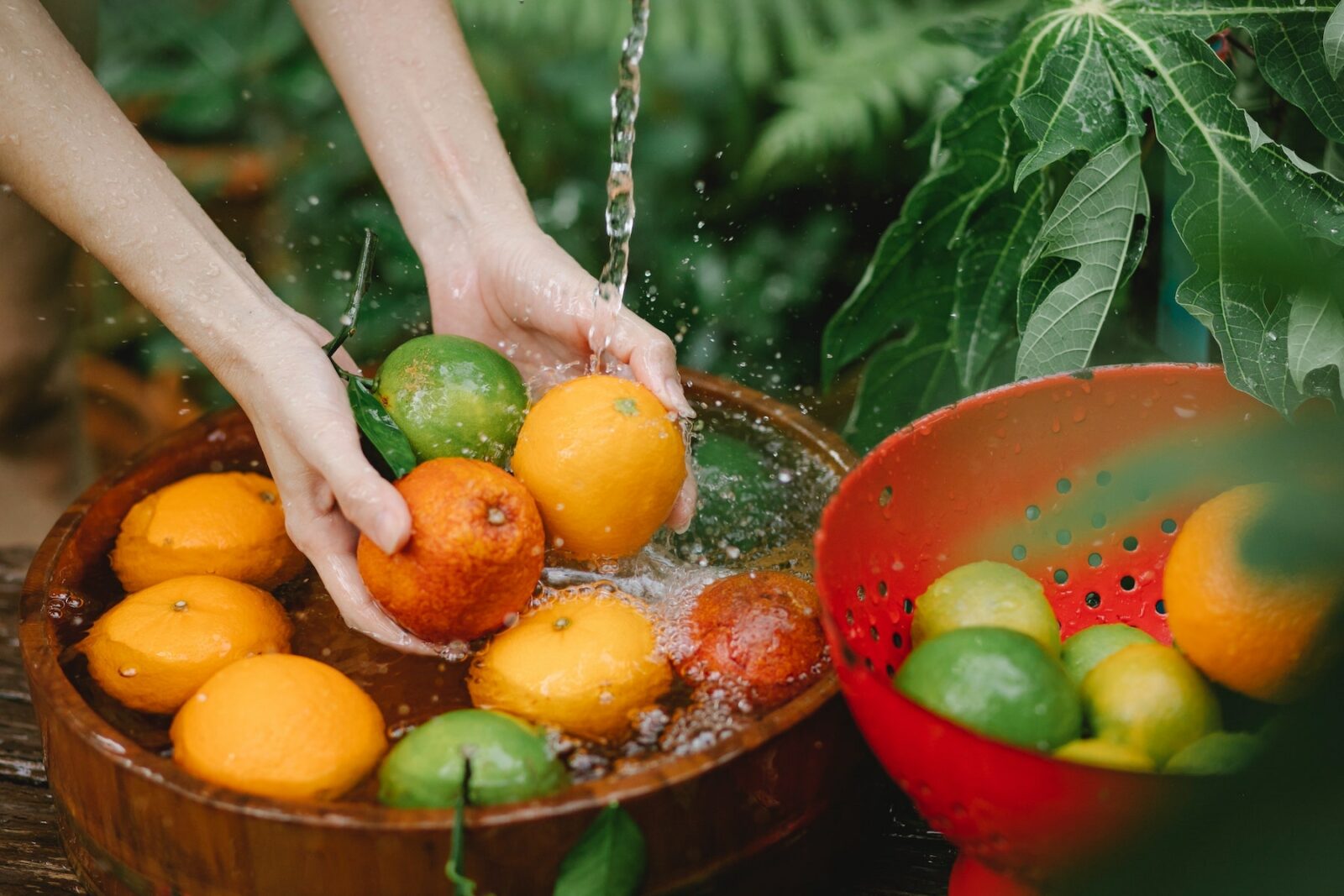
As the health effects of long-term pesticide exposure become increasingly evident, it’s important to thoroughly clean our fruits and vegetables before consumption. This doesn’t just apply to conventionally grown produce but also to organic produce which can be subject to cross-contamination during transportation or from natural sources in the soil or water. Here, we offer some of the safest, most effective ways to minimize your pesticide exposure.
1. Thorough rinsing
The first and most straightforward method is to rinse your fruits and vegetables under running tap water. According to the US Food and Drug Administration (FDA), this can reduce and often eliminate residues on produce (FDA, 2021). It’s advised to rinse under running water rather than soaking or dunking to maximize the removal of lingering residues. For produce with tougher skins like potatoes and carrots, use a vegetable brush to scrub the surface during rinsing.
2. Soaking in a baking soda solution
A study published in the Journal of Agricultural and Food Chemistry in 2017 found that soaking fruits and vegetables in a solution of baking soda and water can effectively remove pesticide residues. The recommended ratio is one teaspoon of baking soda to two cups of water. Allow your produce to soak for about 15-20 minutes, then rinse thoroughly with clean water (Yang et al., 2017).
3. Vinegar wash
Vinegar is another household item that can aid in pesticide removal. Mix a solution of one part vinegar to three parts water. Soak your produce for 20 minutes and then rinse under cold water. This method has been shown to remove surface pesticides along with bacteria and viruses (Ong, 2016).
4. Peeling and trimming
When possible, peeling the skin or outer layer of your produce can effectively reduce pesticide residues. Similarly, trimming outer leaves of leafy vegetables can also help. However, it’s worth noting that peeling may also remove some beneficial nutrients that often reside in the skin or peel (Baker et al., 2002).
5. Blanching
Blanching, or boiling produce briefly, can remove pesticide residues, especially those that are water-soluble. It’s important to blanch only for a short duration to retain the nutritional quality of the produce (Pournourmohammadi et al., 2007).
In conclusion, while it may not be possible to completely eliminate pesticide residues from our produce, these steps can significantly reduce exposure. It is important to use a combination of these methods and practice them consistently for best results.
REFERENCES:
Baker, B. P., Benbrook, C. M., Groth, E., & Benbrook, K. L. (2002). Pesticide residues in conventional, integrated pest management (IPM)-grown and organic foods: insights from three US data sets. Food Additives & Contaminants, 19(5), 427-446.
FDA (2021). 7 Tips for Cleaning Fruits, Vegetables. U.S. Food and Drug Administration. https://www.fda.gov/consumers/consumer-updates/7-tips-cleaning-fruits-vegetables
Ong, M. K., Z. (2016). Efficacy of different washing solutions and contact times on the removal of Escherichia coli O157:H7, methamidophos and chlorpyrifos residues on lettuce. International Food Research Journal, 23(1), 313-319.
Pournourmohammadi, S., Ostad, S. N., Azizi, E., Ghahremani, M. H., Farzadi, L., Minaie, B., & Lamei, N. (2007). Induction of apoptosis in the human leukemia cell line K562 with an ethanol extract of Centaurea cyanus. Phytotherapy Research, 21(3), 260-263.
Yang, T., Doherty, J., Zhao, B., Kinchla, A. J., Clark, J. M., & He, L. (2017). Effectiveness of Commercial and Homemade Washing Agents in Removing Pesticide Residues on and in Apples. Journal of Agricultural and Food Chemistry, 65(44), 9744–9752. https://doi.org/10.1021/acs.jafc.7b03118