
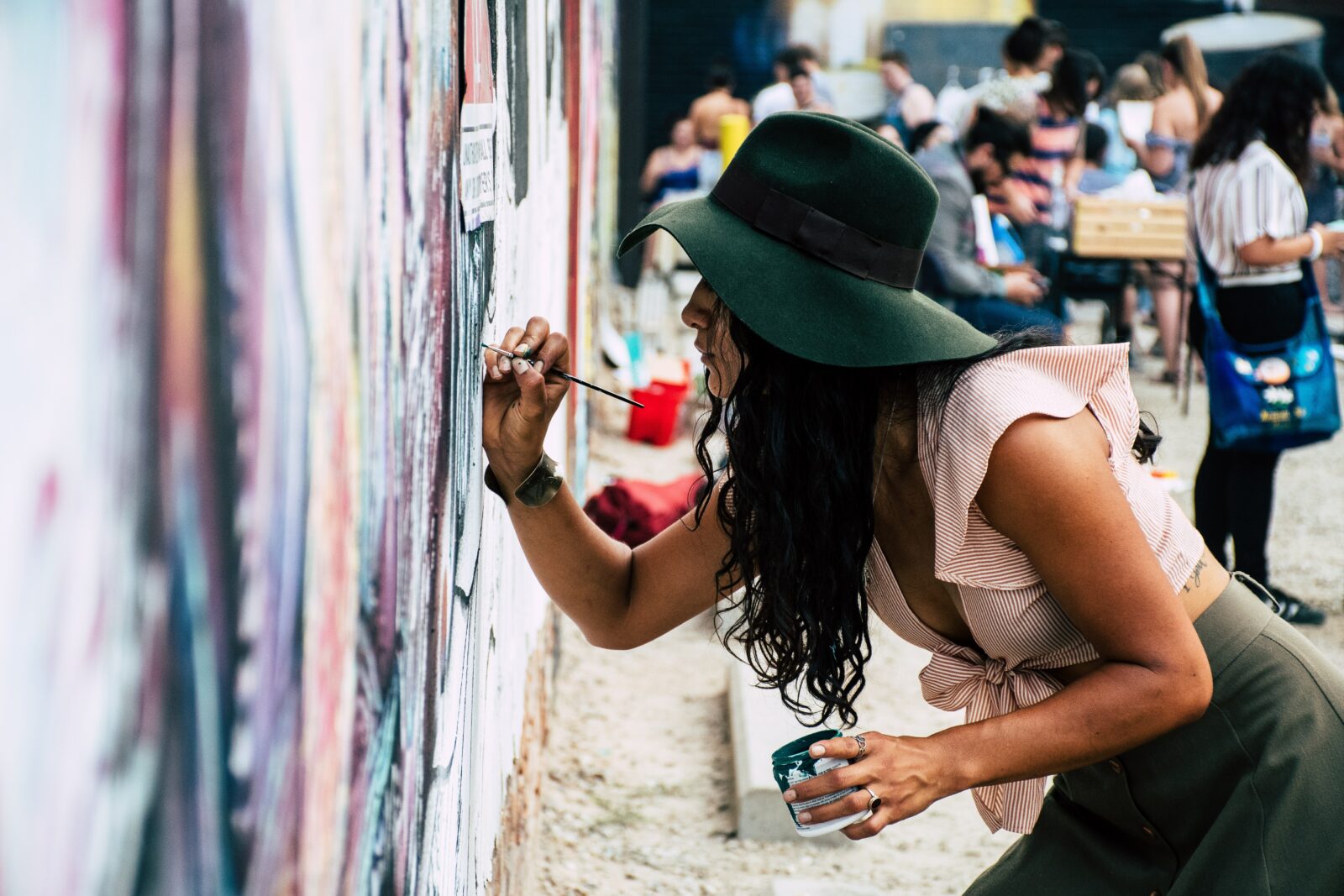
A beautiful tool to support our healing and transformation process is found through honoring the creative process. If you ask most artists and musicians, they will often describe how their art is their therapy. It is a way to take our experiences, both blessed and painful, and channel them into something beautiful. Art and Creativity is a wonderful way to access the feminine within each of us, that creative force that is so often stifled in our society. When working through difficult emotions, such as anger, dancing and drumming can be so powerful to move the energy rather than letting it burn us up from within. Music can be a way to express our grief, painting and drawing is a wonderful way to access our Inner Child. We can work with our shadow, archetypes, traumas and gifts, in a creative and fun way, which for many is a safer and more loving way to begin the process of deeper self knowing, and ultimately healing.
Art and Music Therapy are now well integrated into various treatment facilities and care centers, the value being recognized to support healing, particularly in the mental/emotional realms. The American Art Therapy Association has conducted case studies, and has been able to show that art therapy is useful for broad patient groups. One such study was looking at the therapeutic benefit in a group of patients with Traumatic Brain Injury, which often can have long term exacerbations of depression and anxiety. The patients each participated in 5 one hour sessions, working with various creative processes such as making collages and sculpture. At the completion of the study, 4 of the 6 had a decrease in depression, 3 of the 6, a decrease of anxiety and 5 of 6 had a decrease in stress. This paper also references benefits for patients with schizophrenia, for children and adolescents who experienced trauma, and acute stress disorder. Music therapy also has well documented benefits, within a wide variety of patient groups, such as children with Autistic Spectrum Disorder, Alzheimer’s and Dementia, Schizophrenia.
Music and Art are also an integral part of healing in many shamanic traditions. In Ayahuasca and other Entheogenic Plant ceremonies, the Icaros, or sacred music, is what directs the healing energy of the plants for specific purposes. The shamans describe that each plant has its own song, and that medicine men and women are gifted the songs from nature and spirit to support healing. The music can wind itself within your consciousness, and much like a spiritual/energetic surgery, result in purging of physical, mental, emotional and spiritual disharmony. Moving to different traditions, such as the practices of chanting sacred sounds and mantras in Yogic rituals. Consider also African dance and drumming rituals, Indigneous Australians with the potent didgeridoo, Mongolian and Tibetan Throat Singing, the list expands to include all indigenous traditions, and in fact into modern religious sects as well. Sound Healing is quite common in spiritual communities nowadays, and most of us have experienced some expression of this, whether that be through Crystal Singing Bowls, Gong Sound Baths, Bells and Chimes, Binaural Beats, etc. Most of us also understand that music and the arts, even when not created for the specific purpose of healing, or as a means to access to the divine, is emotionally healing, can be invigorating or relaxing, and often at the top of what we enjoy in life.
During the Water Fasting Retreats in Hawaii, I brought a Shamanic Art and Music Therapist to do a healing session with the patients, and often they would say it was surprisingly one of their most therapeutic experiences during their stay. Particularly for those who don’t consider themselves artists, or those who felt uncomfortable or unskilled in these areas. I will share the flow, and what I learned through participating and witnessing others’ healing experiences, so that perhaps those of you reading this article can create a similar ritual for yourself. The path and purpose was/is to bring people into a relaxed and centered place, moving out of the conscious mind and instead accessing the higher self, or hidden places within the shadows or subconscious mind. Through a series of activities, participants become connected to the intuitive self, such that when they sit down to paint, it is an expression of their soul, or what their soul wished to create or speak at that time.
Creating an creative healing experience
What will you need:
- Set aside an hour or so for the experience. It can be a wonderful thing to share with friends or partners. You want somewhere you will not be disturbed, where you feel safe either inside or outside.
- Some tools for painting or drawing:
- Canvas, Paint Brushes and A Set of Acrylic Paints
- If you are working with healing your inner child, oil pastels are wonderful as they are kind of like adult crayons
- If you are working with healing your shadow, Charcoal is great, as it is dark and easily blended. Creating a self portrait in Charcoal can be very therapeutic.
- Music: Ideally create a playlist that will last for an hour.
- Pick a song first that is meditative, then one that you would enjoy dancing to (drumming tracks are great for this part), and then lastly a few songs that are calm for the art creation. Sometimes choosing songs without words can be nice to not distract the mind.
- Journal or Paper to write down Intentions and Experiences.
- Plant Ally:
- Tea or Tincture of some kind to enhance the experience. A dream enhancing blend can be nice, or even a flower essence or plant medicine depending on your individual practice and location.
- Mindset/Intention
- In general, having a foundation of curiosity, playfulness as opposed to overly serious can help the session to be both more enjoyable and more effective.
- In the realm of art, it can often bring up our inner critic, or inner judge, which is useful to see and also be aware that this session is not about creating a masterpiece or technically advanced piece of artwork. It is more so to see what comes out when we create or express ourselves from that centered and intentional space.
- Set an intention to connect with your inner self, intuition, or perhaps if you are working on healing a specific aspect of self, such as inner child or inner feminine, create a specific intention to direct the session towards that purpose.
The Flow:
- Set the scene. Get your art supplies ready and set up. Perhaps burn some resin or smudging plant of your choice, or diffuse essential oils.
- Sit with your intention, hold it close, speak it aloud, write it down. Whatever helps you to feel as though you are creating a container and direction for your healing practice.
- Take a few moments to sit quietly, get comfortable and sit in meditation for 5-10 minutes. Beginning with breath work can be a great place to start. Finding a guided meditation to bring you into deep presence with the moment and within your body. Chanting or Toning can also really help to calm the nervous system, quiet the mind and allow for that inner voice to come forth.
- After the initial meditation, turn the music towards something that encourages movement. Being with gentle stretching, rolling hips and neck. Now begin to move without thinking about it, the stranger the better here as we are trying to call forth that wild self, the inner child and authentic creative within. Ask your soul, your spirit, your inner child, how she/he/they wishes to move and see what happens. Ideally you will get your heart rate up and start to feel very embodied, in other words your sense of self is deeply connected to your body, as opposed to just within the mind.
- After the dance section sit down in front of your art supplies. Take a few moments and deep calming breaths to lower the heart rate after the dance/movement.
- Begin to create your visual art piece, inviting your soul to speak. Paint or draw in whatever way feels fun and free, this can be specific forms and just patterns, colors. Try and sit for at least 20 minutes adding to your art piece, unless you find yourself finished.
- When you are finished, sit and observe your piece. What does it bring up in you when you look at it? How did it feel to create it? What do you see, feel upon observing, after the whole process? Perhaps journal about your experiences.
Through such explorations, we can get to know our inner self. We can learn how and what it is that we wish to express. We can also bump up against blocks to expression, or judgment within our process of creativity/expression. If healing our inner child is our purpose, we often tune into experiences from our past which resulted in suppression of our wild, pure innocent expression of self. If working on the shadows, we can find ourselves seeing and noticing the darkness, perhaps our work of art is dark, scary or full of emotion. Do you like what you created, and is there a way you can appreciate what you have created more deeply? Can you love what you created as it is a part of you? I encourage you to keep your creation in a place that is visible to remind you of the process and messages received as you move through regular walking and waking life.
Happy Healing!
REFERENCES
Bitonte RA, De Santo M. Art Therapy: An Underutilized, yet Effective Tool. Ment Illn. 2014;6(1):5354. Published 2014 Jul 3. doi:10.4081/mi.2014.5354
Geretsegger M, Elefant C, Mössler KA, Gold C. Music therapy for people with autism spectrum disorder. Cochrane Database Syst Rev. 2014;2014(6):CD004381. Published 2014 Jun 17. doi:10.1002/14651858.CD004381.pub3
Geretsegger M, Mössler KA, Bieleninik Ł, Chen XJ, Heldal TO, Gold C. Music therapy for people with schizophrenia and schizophrenia-like disorders. Cochrane Database Syst Rev. 2017;5(5):CD004025. Published 2017 May 29. doi:10.1002/14651858.CD004025.pub4