
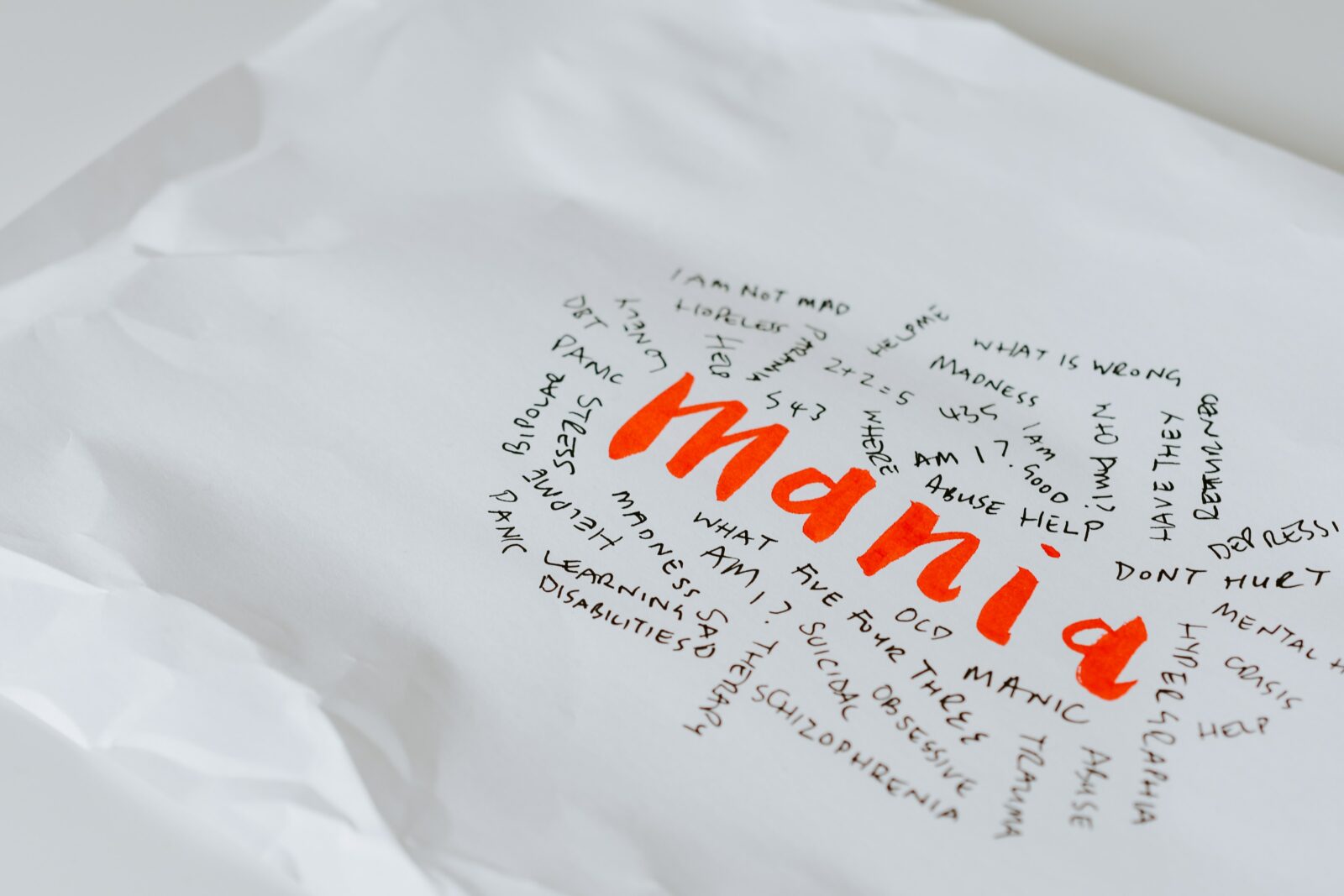
Psychiatrists make a significant effort to interpret the words, sentences, tonality, cadence, and dynamics of their clients as they speak. The features of our speech convey our moods and emotions. While modern psychiatry has advanced methods to help diagnose, such as neuroimaging and magnetoencephalography, a patient’s speech is still the primary way to measure thoughts and emotions.
Speech and schizophrenia
Doctors have long recognized speech and language disturbance as core elements in schizophrenia. Emil Kraepelin, MD, (1856-1926) first described dementia praecox, which has positive symptoms (incoherence, derailment, stereotypy, and neologisms), and negative symptoms (mutism, alogia, affect flattening).
Kraepelin wrote:
“Incoherence of the train of thought…is usually distinctly noticeable in the conversation of the patients. The most different ideas follow one another with most bewildering want of connection, even when patients are quite quiet. A patient said ‘Life is a dessert-spoon,’ another, ‘We are already standing in the spiral under a hammer,’ a third, ‘Death will be awakened by the golden dagger.’”
Kraepelin also noted that speech abnormalities included content, prosody, and vocal qualities. “The cadence often lacks the risings and fallings, the melodies of speech.” Kraepelin and other doctors studying schizophrenia found that speech and language disturbances indicated impairment in communication and disordered thought.
Nancy Andreasen, MD, Ph.D., is currently the Andrew H. Woods Chair of Psychiatry at the University of Iowa Roy J. and Lucille A. Carver College of Medicine. She was a pioneer in formalizing the assessment and measurement of thought disorder with the 1986 Scale for the Assessment of Thought Language and Communication (TLC).
The TLC measures 18 areas of speech disturbances each focused on the content of speech. Items measure negative thought disorder (eg, poverty of speech, poverty of content of speech) and positive thought disorder (eg, derailment, pressure of speech, incoherence, etc). With the TLC and other scales, researchers were able to quantify speech disturbances in people with schizophrenia. They found that many of the features of speech disturbances are shared with patients in manic episodes. However, schizophrenia is more associated with negative thought disorder while mania is more associated with positive thought disorder.
Artificial intelligence and speech measurement
Artificial intelligence and machine learning are providing new tools for measuring speech and thought disturbance. These abilities fall into one of two categories: 1) acoustics analysis which quantifies pitch, amplitude, and vocal qualities and 2) lexical analysis that analyzes the content of speech like grammar, word choice, ideas conveyed, and the relationship between the content and ideas. Natural language processing (NLP) uses AI to extract data from the spoken language and produce naturalistic language. This is further helping scientists measure speech and thought disturbances.
In 2007, researchers applied NLP to studying schizophrenia. They used latent semantic analysis to assign vector representatives, such as speech content from people with schizophrenia. Using this method, they quantified greater gaps in speech and compared those gaps to individuals without schizophrenia. The result was an objective method to measure the space between thoughts.
In another study, scientists used latent semantic analysis that showed decreased coherence predicted which young people were at clinical risk for psychosis that would later develop into schizophrenia. A second study found the same results using a different method, which quantified the density and richness of ideas conveyed through speech.
Other research used graph theory to illustrate the relationship between words and ideas and the loosely connected verbosity in people with mania versus the disconnected, impoverished speech of individuals with schizophrenia. Some connections have been made between social media communication. NLP methods were able to predict subsequent rehospitalizations based on Facebook posts.
Scientists are now comparing traditional rating scales with NLP techniques to differentiate speech between people with schizophrenia and those without. They found that machine learning algorithms performed significantly better when using NLP-derived features versus conventional clinical ratings. The machine learning algorithms caught much more important information. It also found preliminary evidence that people with schizophrenia speak in partial words much more than those without the disorder.
Researchers are also combining acoustic and lexical speech features in machine learning models to obtain more accurate predictions that include multifaceted speech disturbances typical of schizophrenia.
The future of speech biomarkers
Using advanced technology to measure thoughts in an objective and efficient way means that speech biomarkers may change the future or clinical psychiatric practice. Speech is the audible extension of alterations in thought and brain function that are at the core of schizophrenia.
Artificial intelligence and human language processing are enabling researchers to map the connections. The future may be using language to map the brain and develop more personalized medicine.
Speech may indicate other underlying disease processes
The recent developments in measuring and analyzing speech disturbances in schizophrenia may lead to innovative tools to help doctors help their patients. In the near future, patients may be able to use a tablet with special software that has them perform several speaking tasks. The software analyzes the speech, produces graphs that reflect their symptoms and the correlated brain circuitry, and offers recommendations on medications and psychotherapy. The software could track progress and predict a potential relapse before it occurs. The method would be similar to checking autoantibodies in rheumatology, cancer markers in oncology, or other types of markers in other medical fields.
The early evidence suggests that speech biomarkers may be an effective way to examine the underlying changes in the brain. The work taking place that analyzes the speech differentiation between people with schizophrenia and mania is a driving force for innovation. With additional research, scientists may be able to link specific speech markers to alterations in specific circuits.
Final thoughts
This is exciting research. The possibilities for new, innovative ways to help those with schizophrenia are a welcome development. Still, the technology should not replace humans in the field of psychiatry. The availability of brain measures should enhance diagnosis and improve psychosocial interventions rather than simply prescribe more medication. Natural language processing can provide insights into changes in thought and brain structure on an individualized basis. This new technology should enable clinicians to garner specific data on each unique case.