

We have the ability to directly affect our physiology, and specifically our nervous system. Ancient traditions of healing and spirituality have described this ability for millenia. And now, through our modern research interests and capability, we are beginning to discover the mechanisms by which these practices benefit us on all levels: cellular, psychological, etc.
For those seeking to understand the Mind Heart Body Connection, and harness it for healing and empowerment, it is quite an exciting time. That which has intuitively felt beneficial, and clinically proven to be essential, is now being described both in the language of science and spirit.
Today we will focus on the Breath, and specifically the technique referred to as Diaphragmatic Breathing, or Deep Belly Breathing. We will start with a simple discussion of the concept of Vagal Tone. This will help to set the stage as we explore how this simple practice has profound and lasting benefits to our health, physically, emotionally and mentally.
What is vagal tone?
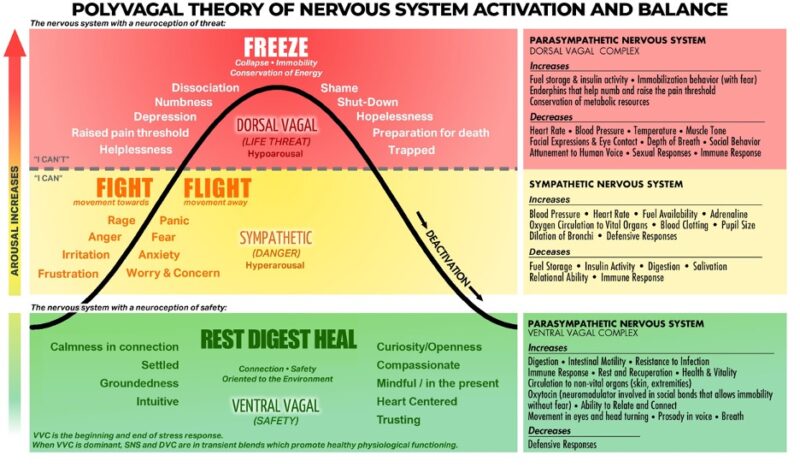
Vagal tone is a way of referencing the balance of our nervous system. The concept of “Enhancing Vagal Tone” means encouraging activation of the Ventral Vagal branch of the Parasympathetic Nervous System. This branch governs our ability to heal, relax, digest and be at peace. So often, whether due to mental, emotional or physical stress, we end up stuck in a sympathetic dominant state. Sympathetic dominance is accompanied physiologically with elevated levels of cortisol, elevated heart rate, reduced heart rate variability, and overall higher levels of tension within the system. All of which are associated with increased incidence of chronic disease.
There is a stage beyond this referred to as “Freeze”, and is often entered after prolonged or extreme stress and/or trauma. In Polyvagal Theory this experience is mediated by the “Dorsal Vagal” branch of the parasympathetic system. When this branch is activated, we essentially shut down, succumb to overwhelm and sometimes even dissociate from our body and present circumstances. While all of these functions or states serve a purpose, and are essential for a balanced biological and mental functioning, the issue comes in when we are stuck in fight/flight/freeze, and in many cases we don’t even realize this is where we are operating from.
When we struggle with anxiety, this can be exacerbated even more so. And even for those who don’t identify with anxiety, there is often still this tendency to have our modus operandi to fall within that sympathetic side of things. Overall, most of us can benefit from assessing and tending to our nervous system balance. The fact is that our lives are so full: we are surrounded by noise, we spend a lot of time indoors and on screens, we have busy work and school schedules, as well as homes and relationships to maintain. With this load it is no wonder that most of us are always “on”. Our attention is needed for so much, so how can we realistically tend to ourselves in a way that keeps us getting all of our to do lists done, while also supporting our health and healing?
The first step is to assess where you are at on the scale, or rather, where you tend to hang out the most, and then from there making a conscious choice to shift towards a more calm resting state
How to determine vagal tone?
Here are some questions to ask yourself to help you discern your vagal tone i.e. nervous system set point:
- Do you tend to rush through tasks, especially such as doing dishes, cleaning, checking emails?
- Do you tend to pick up your phone a lot throughout the day? Or right upon waking?
- Are you present during tasks? Or does your mind tend to skip ahead, or wander around to other “to dos”?
- How easy are you able to fall asleep? If it takes a long time for you to unwind at night this is often related to a sympathetic dominant state.
- Would you characterize yourself as a perfectionist? Often this tendency results in a constant “on” mode, and is associated with higher anxiety.
- Do you have space in your day for silence, relaxation, simple joys? Are you able to sit in silence comfortably? Are you able to meditate comfortably?
- What is your resting pulse? How responsive are your pupils to light? Do they contract and dilate easily? When you pay attention to your breath, do you notice that your pulse quickens with the inhale and slows with the exhale? The more flexibility in pulse rate and contractility, the better parasympathetic response you have.
- There are simple observation techniques as well including checking if your uvula pulls to one side during an open mouth “ahhh”.
Now from a state of self-awareness, we can use breathwork to consciously calm our Nervous System set point.
The science behind breathwork
There are so many ways to support relaxing your nervous system. One of the most basic, easiest and effective ways is through conscious breathing, and specifically through Diaphragmatic Breathing. Diaphragmatic breathing involves contraction of the diaphragm, expansion of the belly, and deepening and lengthening of inhalation and exhalation. This decreases the rate at which we breathe, maximizes gas exchange (Oxygen and Carbon Dioxide).
Diaphragmatic Breathing massages the digestive system, especially the gallbladder, liver and stomach, supporting circulation, function and drainage of these organs. This also then of course encourages movement and drainage of the lymphatic system, both through the direct physical movement and the overall physiologic/nervous system effects.
In a review of the literature, there are a plethora of various studies exploring the benefits of this practice.
Physiologic Benefits of Breathwork
- Reduced blood pressure, increased Heart Rate Variability and Oxygenation.
- Enhanced Pulmonary Function, Cardiorespiratory fitness and respiratory muscle strength.
- In patients with COPD (Chronic Obstructive Pulmonary Disorder), diaphragmatic breathing exercise increased the diaphragm involvement in natural breathing, which enhanced pulmonary function tests, and overall exercise endurance.
- Measurable and Sustained reductions in Salivary Cortisol levels and increased melatonin levels, lowering overall oxidative stress.
Cognitive/Emotional Benefits of Breathwork
- Enhance attention and Cognitive Processing. EEG studies have suggested that regular breathing practice during yoga and meditation can increase Beta-activity in the left frontal, midline, and occipital brain regions, which are associated with enhanced cognitive performance, such as during attention, memory, and executive functions.
- Even brief breathwork training enhanced sustained attention while at the same time reducing fatigue and anxiety.
- Psychological studies have revealed breathing practice to be an effective non-pharmacological intervention for emotional wellbeing, including a reduction in anxiety, depression, and stress.
- Breathing practices are widely applied in clinical settings for mental conditions: PTSD, Motion Disorders, Phobias and other stress-related emotional disorders.
- Brain imaging studies support the hypothesis that breathing stimulates vagal activation of GABA pathways from the prefrontal cortex and insula, to inhibit amygdala overactivity. The amygdala is related to peak fear/emotional states and memory, so essentially this means that breathing enhances our sense of balance and emotional wellbeing.
By incorporating regular mindful breathing practices into our daily rituals, we eventually shift the way we breathe in our regular walking and waking life, which then shifts our nervous system set point to one that is more supportive of Healing and Wellbeing. In clinical practice, I have seen breathwork stop panic attacks, and reduce the discomfort of Herxheimer reactions during detoxification and essentially be a key practice that shifts one out of a cycle of Dis-ease into one of Wellbeing. Breathing alone can bring one into transformational and transcendent states, that of deep connection to the heart, to the self, nature and our universal existence.
The beautiful thing about the breath is that it is something that we already naturally do, an average of 20,000 times per day. Taking a few minutes several times a day to pause and focus on Diaphragmatic breathing retrains your natural breathing to be slower, and deeper. This happens rather quickly in fact, and helps to reprogram your resting nervous system tone to be more relaxed. This also sets a stronger foundation for remaining grounded and focused in waking life, enhancing resilience to stress and emotional ebbs and flows.
For a guided practice and instruction in Diaphragmatic Breathing, check out Webinar 3: Breathwork for Relaxation.
Happy Healing!
REFERENCES
Yamaguti WP, Claudino RC, Neto AP, Chammas MC, Gomes AC, Salge JM, Moriya HT, Cukier A, Carvalho CR. Diaphragmatic breathing training program improves abdominal motion during natural breathing in patients with chronic obstructive pulmonary disease: a randomized controlled trial. Arch Phys Med Rehabil. 2012 Apr;93(4):571-7. doi: 10.1016/j.apmr.2011.11.026. PMID: 22464088.
Ma X, Yue ZQ, Gong ZQ, et al. The Effect of Diaphragmatic Breathing on Attention, Negative Affect and Stress in Healthy Adults. Front Psychol. 2017;8:874. Published 2017 Jun 6. doi:10.3389/fpsyg.2017.00874
Martarelli D, Cocchioni M, Scuri S, Pompei P. Diaphragmatic breathing reduces exercise-induced oxidative stress. Evid Based Complement Alternat Med. 2011;2011:932430. doi: 10.1093/ecam/nep169. Epub 2011 Feb 10. PMID: 19875429; PMCID: PMC3139518.
Gerritsen RJS, Band GPH. Breath of Life: The Respiratory Vagal Stimulation Model of Contemplative Activity. Front Hum Neurosci. 2018;12:397. Published 2018 Oct 9. doi:10.3389/fnhum.2018.00397