

In 2017, lead exposure accounted for 1.06 million deaths and 24.4 million years of healthy life lost worldwide.1 The highest burden was in low- and middle-income countries. The Institute for Health Metrics and Evaluation also estimated that in 2016, lead exposure accounted for 63.2% of the global burden of idiopathic developmental intellectual disability, 10.3% of the global burden of hypertensive heart disease, 5.6% of the global burden of ischemic heart disease, and 6.2% of the global burden of stroke.1
In adults, sufficient evidence suggests that blood lead levels (BLLs) <5 ?g/dL are associated with decreased renal function and that BLLs <10 ?g/dL are associated with increased blood pressure and hypertension.2
Lead is one of the most widely used metals in the world,3 and although it is toxic, it has been incorporated into many different products, including paints, cosmetics, fuel, etc., for its unique properties like a low melting point and resistance to corrosion.4 However, lead persists in the environment and cannot be metabolized in the human body.3 It can enter the body via a variety of routes; e.g., particles from lead-based paint or housing renovation can adhere to food and be ingested, and industries that use lead in manufacturing can pollute the air and soil, exposing humans via the food chain.5
An interesting study in 2019 looked at differing sources of lead exposure in various countries. Sources include:
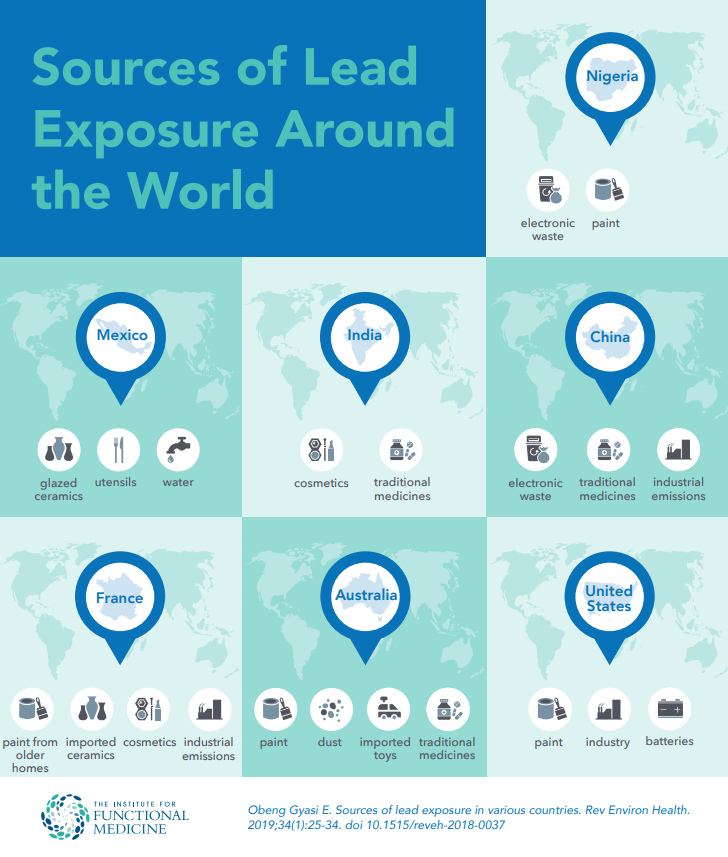
Lead can be absorbed by the intestine and through the skin, and almost 90% of it binds to erythrocyte proteins.4 Once inside the human body, lead may travel to different tissues and organs, including the liver and kidneys, where it can cause oxidative damage to cells and tissues, including uncoupling the respiratory chain in mitochondria.4 DNA damage is a significant consequence of oxidative stress.3
A 2018 study provided the first published evidence that lead exposure results in DNA damage via promoting oxidative stress and promoter methylation of DNA repair genes in human lymphoblastoid TK6 cells.3 This study was carried out on only one human cell line, whereas the obtained results need to be verified in multiple human cell lines, and the role of DNA repair proteins in lead-induced genotoxicity is unclear and needs further elucidation. Taken together, however, the study results indicate that lead exposure decreased cell viability, induced oxidative stress–mediated DNA damage via the Nrf2-ARE signaling pathway, and decreased the expression of DNA repair genes.3
Lead exposure and cardiovascular disease
Cardiovascular diseases are the primary cause of mortality in the world.7 Lead’s effect on the cardiovascular system and cardiovascular-related markers has been well noted in the literature.8,9 The mechanism by which lead induces hypertension may be related to oxidative stress, inflammation, alterations in the renin-angiotensin-aldosterone system, alteration of vasoactive and volume regulatory hormones, and nitric oxide dysregulation, among other mechanisms.8,9
A 2018 study published in The Lancet Public Health suggests that of the 2.3 million deaths every year in the US, about 400,000 are attributable to lead exposure, of which 250,000 are from cardiovascular disease.10 This estimate is about 10x larger than previous approximations.10
A 2019 US cross-sectional study showed that lead exposure affects cardiovascular markers in young and middle-aged adults (18-65 years), with higher exposure increasing with age and generally resulting in worse health outcomes.8 The study suggests that increasing levels of lead exposure may contribute to people being propelled toward various cardiovascular pathologies.8
Other conditions associated with lead exposure include:
- Cardiovascular disease due to telomere shortening and lipid disturbance.11
- Peripheral arterial disease, electrocardiographic abnormalities, and left-ventricular hypertrophy.10
- Kidney damage via oxidative stress and lipid peroxidation.4
- Respiratory, neurologic, digestive, and urinary diseases.12
Lead exposure in children
In children, there is no identified threshold or “safe” blood lead level below which no risk of poor developmental or intellectual function is expected.2 Young children are particularly vulnerable to lead poisoning because they absorb four to five times as much ingested lead as adults from a given source.1 Four million US households with children are exposed to high lead levels, and approximately 500,000 US children aged one to five years have blood lead levels (BLLs) higher than 5 µg/dL, the level at which public health action is recommended.13
A 2019 study—the longest and largest psychiatric follow-up study involving children tested for lead exposure to date—found BLLs above the level for clinical and environmental responses in 94% of the children.13 Childhood BLL was significantly associated with higher general psychopathology as well as internalizing and thought disorder symptoms into adulthood. Childhood BLL was also significantly associated with lower conscientiousness and agreeableness and higher neuroticism in adulthood.13
A study published in Environmental Health Perspectives found that there is no safety margin at existing exposures.14 Despite seeing a reduction in lead exposure over time, Koller et al state that it could be argued that current baseline blood levels continue to constitute a global public health risk.14
Observational studies have found an association between prenatal exposure to lead and an increased risk of schizophrenia and antisocial behaviors in adulthood.13 A 2017 JAMA study linked higher childhood lead exposure with lower IQ scores and downward social mobility in adulthood,15 and a population-based case-controlled study suggests that exposure to lead may also be associated with an increased risk for neonatal orofacial clefts.16
It is interesting to note that while thousands of children in the US have elevated blood lead concentrations, many of them are asymptomatic.17 The primary concern in this group is that multiple meta-analyses have demonstrated that, even at low blood lead concentrations, there is an inverse relationship between blood lead concentrations and intelligence quotient scores and markers of academic achievement. Furthermore, some research suggests that the dose-response curve is steeper at lower blood lead concentrations, meaning that the number of IQ points lost per unit increase in blood lead concentration is higher in the 1 to 10 mcg/dL lead range than in the 10 to 20 mcg/dL range.17
Emerging research
A recent study suggests that the regular consumption of beverages in glazed, ceramic cups increases the chances of lead-related health risks.18 The chronic daily intake of lead by children and adults, respectively, consuming from new ceramic cups were 1.3–5× and 1.28–6× more than that from old ceramic cups. In both cases, intake values far exceeded the WHO reference dose of 0.0006 mg Pb/kg bw/day in children (<11 years) and 0.0013 mg Pb/kg bw/day in adults. According to the study, these levels of lead consumption in children might be predicted to be associated with a decrement in IQ by at least one point and associated with adverse effects in adults, especially in women of childbearing age.18
Studies suggest that lead is a carcinogenic factor in animal models, and epidemiological studies have suggested an association between blood lead concentration and death rate due to cancer in a number of populations, including in the US,19 South Korea,20 and Australia.21 In June 2018, the first study to demonstrate urinary lead concentration as an independent predictor of cancer mortality in the general population was published in Frontiers in Oncology.5 Using National Health and Nutrition Examination Survey 1999-2010 data and its Mortality Follow-Up study, Li et al found that “despite the marked decrease in environmental lead levels over the past three decades, lead exposure remains a significant determinant of cancer mortality in general population in US, and quantification of urinary lead may serve as a non-invasive approach to facilitate biomarker discovery and clinical translational research.”5
Conclusion
While the concept that toxins accumulate in the body and are the cause of various health problems has long been a fundamental tenet of traditional healthcare systems around the world, researchers have learned a great deal in recent years about how toxins and toxicants affect us, where they originate, and how to improve our ability to detoxify in a toxic world. Understanding toxicity and taking practical steps to improve biotransformation are essential and critical pieces in any integrative approach to your patients’ health and well-being.
The most important aspect of management in a patient with an elevated blood lead concentration is identifying the source of lead and removing it from the patient’s environment.17
REFERENCES
- World Health Organization. Lead poisoning and health. Published August 23, 2019. Accessed April 27, 2020. https://www.who.int/news-room/fact-sheets/detail/lead-poisoning-and-health
- Agency for Toxic Substances and Disease Registry. Lead toxicity: what are possible health effects from lead exposure? Published July 2, 2019. Accessed April 27, 2020. https://www.atsdr.cdc.gov/csem/csem.asp?csem=34&po=10
- Liu X, Wu J, Shi W, Shi W, Liu H, Wu X. Lead induces genotoxicity via oxidative stress and promoter methylation of DNA repair genes in human lymphoblastoid TK6 cells. Med Sci Monit. 2018;24:4295-4304. doi:12659/MSM.908425
- Rana MN, Tangpong J, Rahman MM. Toxicodynamics of lead, cadmium, mercury and arsenic-induced kidney toxicity and treatment strategy: a mini review. Toxicol Rep. 2018;5:704-713. doi:1016/j.toxrep.2018.05.012
- Li S, Wang J, Zhang B, et al. Urinary lead concentration is an independent predictor of cancer mortality in the U.S. general population. Front Oncol. 2018;8:242. doi:3389/fonc.2018.00242
- Obeng-Gyasi E. Sources of lead exposure in various countries. Rev Environ Health. 2019;34(1):25-34. doi:1515/reveh-2018-0037
- Carter HE, Schofield D, Shrestha R. Productivity costs of cardiovascular disease mortality across disease types and socioeconomic groups. Open Heart. 2019;6(1):e000939. doi:1136/openhrt-2018-000939
- Obeng-Gyasi E. Lead exposure and cardiovascular disease among young and middle-aged adults. Med Sci. 2019;7(11):E103. doi:3390/medsci7110103
- Vaziri ND. Mechanisms of lead-induced hypertension and cardiovascular disease. Am J Physiol Heart Circ Physiol. 2008;295(2):H454-H465. doi:1152/ajpheart.00158.2008
- Lanphear BP, Rauch S, Auinger P, Allen RW, Hornung RW. Low-level lead exposure and mortality in US adults: a population-based cohort study. Lancet Public Health. 2018;(3)4:e177-e184. doi:1016/S2468-2667(18)30025-2
- He L, Chen Z, Dai B, Li G, Zhu G. Low-level lead exposure and cardiovascular disease: the roles of telomere shortening and lipid disturbance. J Toxicol Sci. 2018;43(11):623-630. doi:2131/jts.43.623
- Boskabady M, Marefati N, Farkhondeh T, Shakeri F, Farshbaf A, Boskabady MH. The effect of environmental lead exposure on human health and the contribution of inflammatory mechanisms, a review. Environ Int. 2018;120:404-420. doi:1016/j.envint.2018.08.013
- Sancar F. Childhood lead exposure may affect personality, mental health in adulthood. JAMA. 2019;321(15):1445-1446. doi:1001/jama.2019.1116
- Koller K, Brown T, Spurgeon A, Levy L. Recent developments in low-level lead exposure and intellectual impairment in children. Environ Health Perspect. 2004;112(9):987-994. doi:1289/ehp.6941
- Reuben A, Caspi A, Belsky DW, et al. Association of childhood blood lead levels with cognitive function and socioeconomic status at age 38 years and with IQ change and socioeconomic mobility between childhood and adulthood. JAMA. 2017;317(12):1244-1251. doi:1001/jama.2017.1712
- Pi X, Qiao Y, Wei Y, et al. Concentrations of selected heavy metals in placental tissues and risk for neonatal orofacial clefts. Environ Pollut. 2018;242(Pt B):1652-1658. doi:1016/j.envpol.2018.07.112
- Halmo L, Nappe TM. Lead Toxicity. StatPearls. Published November 26, 2019. Accessed April 27, 2020. https://www.ncbi.nlm.nih.gov/books/NBK541097/
- Mandal PR, Das S. Leachable lead and cadmium in microwave-heated ceramic cups: possible health hazard to human. Environ Sci Pollut Res Int. 2018;25(29):28954-28960. doi:1007/s11356-018-2944-8
- Cheung MR. Blood lead concentration correlates with all cause, all cancer and lung cancer mortality in adults: a population based study. Asian Pac J Cancer Prev. 2013;14(5):3105-3108. doi:17314/APJCP.2013.14.5.3105
- Kim MG, Ryoo JH, Chang SJ, et al. Blood lead levels and cause-specific mortality of inorganic lead-exposed workers in South Korea. PLoS One. 2015;10(10):e0140360. doi:1371/journal.pone.0140360
- Gwini S, Macfarlane E, Del Monaco A, et al. Cancer incidence, mortality, and blood lead levels among workers exposed to inorganic lead. Ann Epidemiol. 2012;22(4):270-276. doi:1016/j.annepidem.2012.01.003