
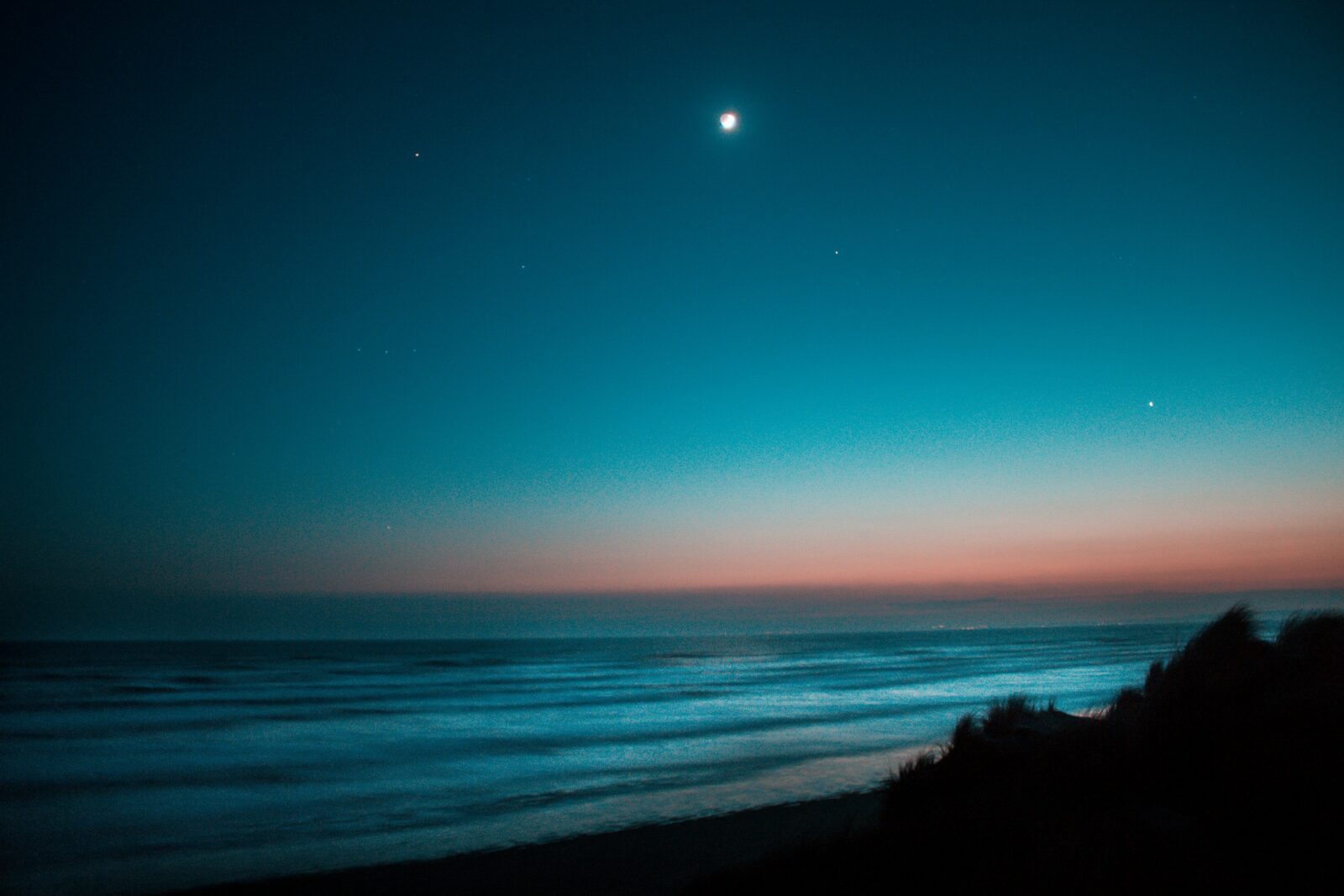
The moon, that celestial body that has fascinated humanity for millennia, exerts a powerful influence over Earth and its elements. One of the most striking phenomena is the moon’s influence on the bodies of water on our planet, such as oceans and seas. There also exists an interesting and ancient connection between the moon and women’s menstrual cycles.
The Moon and the Tides
In fact, it’s naturally understood that the moon influences planet Earth in various ways. It’s known that the moon’s gravity affects ocean tides. The moon’s phases have also been observed to influence marine life, such as fish migration or the reproduction of certain marine species.
Tides are a direct manifestation of the moon’s influence on Earth’s water. The moon’s gravity generates a tidal effect on bodies of water, creating high and low tides in a constant cycle. This phenomenon is especially evident in oceans, where tides can significantly change water levels along coastlines and have a significant ecological impact.
The moon exerts an attractive force on Earth and its water, generating tides that follow a regular pattern related to the moon’s phases. During the full moon and new moon, when the sun, moon, and Earth are aligned, especially high tides known as “spring tides” occur. Conversely, during the first and last quarters, when the sun and moon are at right angles to Earth, more moderate tides known as “neap tides” occur. This cosmic dance between the moon and water influences marine life, navigation, and other aspects of coastal ecosystems.
Our Menstrual Cycle and the Moon
In many cultures, there has always been a belief that the moon influences fertility and women’s natural cycles. In fact, there are terms used to describe menstruation, such as “menstrual moon” or “red moon.” For example, some Native American tribes have observed traditions related to the “Red Moon,” considering women to be more powerful and more connected to nature during their menstruation.
In ancient Egypt, it was also thought that the moon’s phases were related to women’s menstrual cycles. Additionally, the lunar goddess Isis is linked to fertility and motherhood.
Similarly, in Chinese and Hindu cultures, a symbolic connection between the moon and femininity has been established. In Chinese tradition, for instance, there is mention of “lunar energy” associated with women. Across various cultures, lunar cycles have provided the framework for celebrating festivals and rituals related to fertility and life. These festivals often incorporate elements of the moon and its connection to cyclic nature.
Although there may always be those who say there is no scientific basis for linking the moon to women’s cycles, I don’t believe it’s a coincidence that in so many different cultures around the world, there’s this common denominator of connecting one thing with the other.
Furthermore, if you’re familiar with seed cycling, you’ll know that its main idea is to consume different types of seeds during the two main phases of the menstrual cycle: the follicular phase and the luteal phase. For those who don’t have a regular cycle, or if you haven’t started to really track your menstrual phases, it is recommended to follow the moon’s phase.
In this way, the moon helps us regulate the female hormonal cycle.
The power of the moon in relation to the female cycle could be attributed to various factors, such as hormonal changes controlled by an increase or decrease in melatonin, the hormone synthesized when light fades at night. During the full moon, there’s less melatonin secretion because it’s not as dark, and during the new moon, there’s much more synthesis of this hormone, which is a powerful antioxidant and plays a crucial role in controlling inflammation in the body.
Likewise, knowing that water is the main fuel for mitochondria, the small organelles in our cells responsible for producing energy, could it be that the moon’s gravitational power alters the water in our cells, causing mitochondria to react to these changes? There’s a significant number of mitochondria in our oocytes, which, upon fertilization by a sperm cell, create the embryo that gives rise to new life.
Regardless of the exact relationship, the moon remains a powerful and meaningful symbol in many cultures, and its influence over water and nature continues to astound us. Whether through tides shaping our coasts or through mysterious connections to women’s cycles, the moon remains a reminder of the deep connection between the cosmos and our planet.